
Read the full report here.
In 2023, WestEd’s National Research & Development Center to Improve Education for Secondary English Learners (the Center) partnered with Empirical Education Inc. to conduct a one-year study evaluating the effectiveness of the Educative English Language Arts (E-ELA) curriculum, a 12-week eighth-grade program designed to strengthen literacy and academic language development for English Learners (ELs), particularly long-term English Learners (LTELs). LTELs are students who have been enrolled in U.S. schools for six or more years without being reclassified. Although we initially aimed to assess impacts on ELA achievement and English Language Proficiency (ELP) among 8th-grade LTELs in large urban districts, recruitment proved challenging because many districts had recently adopted new curricula (with ESSER funds) and were reluctant to pause implementation. Consequently, we broadened recruitment to a mix of districts, which included classes with fewer LTELs and a wider range of ELP levels, and we delayed implementation until spring 2025.
The Center developed the E-ELA curriculum to expand teacher expertise and improve classroom learning opportunities for ELs through educative instructional materials, professional development (PD) sessions, and coaching. Grounded in WestEd’s Quality Teaching for English Learners (QTEL) framework and sociocultural learning theory, E-ELA emphasizes high-challenge, high-support instruction. The curriculum engages students with rigorous texts, multimodal resources, collaborative discussion, and scaffolded reading and writing tasks. The three instructional units follow a spiraled design that builds analytical, thematic, and language skills across lessons, culminating in student projects. The materials are designed to be educative for teachers, embedding instructional guidance, strategy supports, and structured student interaction routines.
Participants implemented E-ELA in spring 2025 across four school districts: two suburban districts in Western Oregon, one suburban district in Connecticut, and one large urban district in South Texas. These districts vary in size, geography, and student demographics. A total of 20 teachers implemented E-ELA across 46 eighth-grade classes that included either single-teacher and co-teaching models. Participating teachers were either general education ELA or English Language Development (ELD) teachers.
This study presents findings from a quasi-experimental study. Because district recruitment constraints made random assignment infeasible, we compared outcomes for students in E-ELA classrooms with matched comparison students in similar classes receiving their districts’ standard ELA curriculum. We collected student outcome data from state ELA assessments (STAAR and Smarter Balanced) and state English language proficiency assessments (TELPAS, ELPA, and LAS Links). We constructed matched analytic samples using propensity score methods with exact matching by district and EL classification to ensure baseline equivalence.
In addition to estimating impacts on student ELA achievement and ELP outcomes, we examined implementation fidelity and teacher experience. We collected implementation data through PD observations, teacher surveys, program data, and teacher interviews. These data document how teachers engaged with the PD and coaching model, how teachers enacted the curriculum units in classrooms, and what factors supported or constrained successful implementation and student engagement.
Teachers' implementation of the E-ELA curriculum occurred under generally supportive conditions. Most teachers (90%, n = 18) attended all professional development sessions, felt prepared to teach the units, and expressed enthusiasm about bringing the curriculum into their classrooms. Teachers valued receiving materials in advance, engaging in experiential learning during PD, and participating in coaching conversations that provided informed, constructive feedback.
Across units, teachers consistently reported that E-ELA materials were engaging, standards-aligned, and appropriate for students, and that they had sufficient preparation time for instruction. Their perceptions varied by unit, however. Specifically,
Despite these differences, teachers overall viewed the curriculum as more suitable for their students than typical ELA materials and reported strong alignment with school, district, and state expectations (Table 1).
TABLE 1. PERCENTAGE OF TEACHERS AGREEING OR STRONGLY AGREEING ABOUT THE SUITABILITY OF E-ELA CURRICULUM UNITS VERSUS TYPICAL 8TH GRADE ELA CURRICULUM |
||||
| Typical 8th grade curriculum (n = 20) | E-ELA Unit 1 (n = 20) | E-ELA Unit 2 (n = 18) | E-ELA Unit 3 (n = 19) | |
|
Engaging to students |
9 (45%) | 17 (85%) | 15 (83%) | 16 (84%) |
|
Meeting the needs of ELs |
9 (45%) | 14 (70%) | 13 (72%) | 14 (73%) |
|
Culturally relevant |
9 (45%) | 12 (60%) | 13 (72%) | 17 (90%) |
|
|
||||
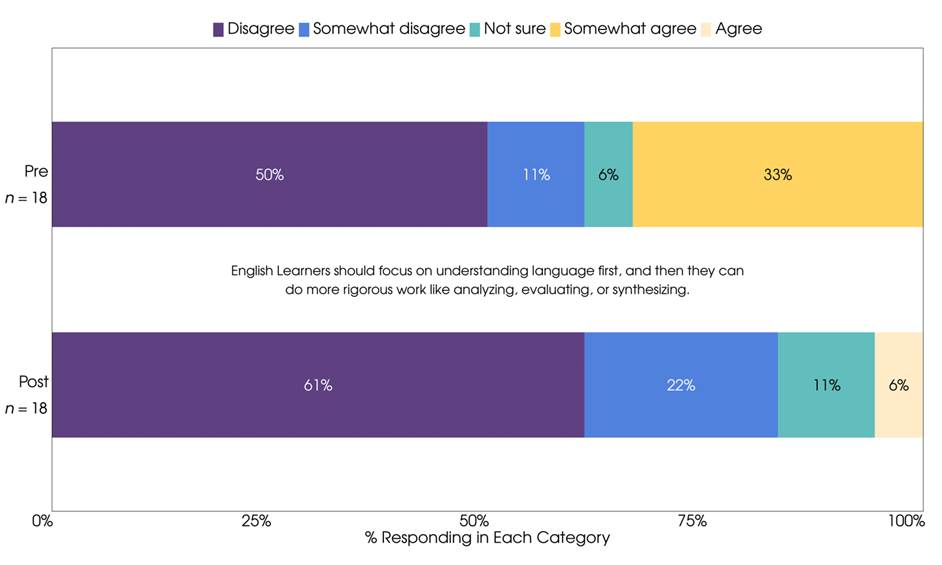
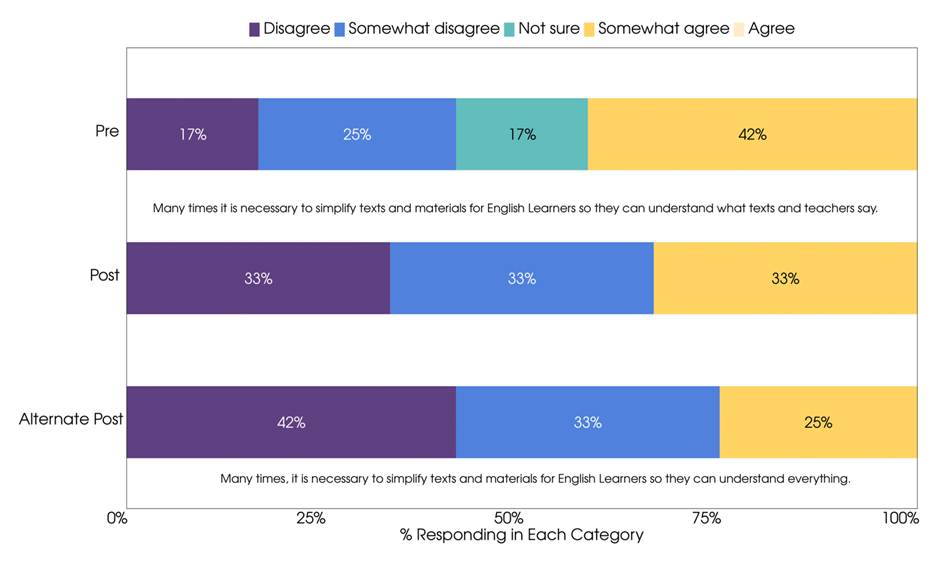
Following implementation, teachers reported meaningful changes in their instructional beliefs about English Learners. Fewer teachers endorsed simplifying content, isolating vocabulary instruction, or limiting rigorous collaborative work for ELs. Instead, teachers increasingly recognized that EL students can engage in grade-level, intellectually demanding learning experiences while developing academic language. These shifts suggest that implementation influenced not only classroom practice, but also broader beliefs about EL capability and access to rigor (Figures 1 and 2).
Many educators reported anecdotally that E-ELA improved students' ELP and shared plans to continue using E-ELA strategies in future years. However, scheduling demands and competing school priorities made full implementation difficult. Some teachers were unable to complete all coaching cycles or finish the full sequence of units within the planned 12-week timeline. In classrooms with mixed English proficiency levels and students with disabilities, teachers also made minor pedagogical adaptations to meet the needs of all their students.
Overall, our implementation results indicate that E-ELA is engaging and instructionally meaningful for teachers, while also revealing practical factors that influence successful delivery. Our findings provide critical insight for strengthening future implementation and supporting broader adoption.
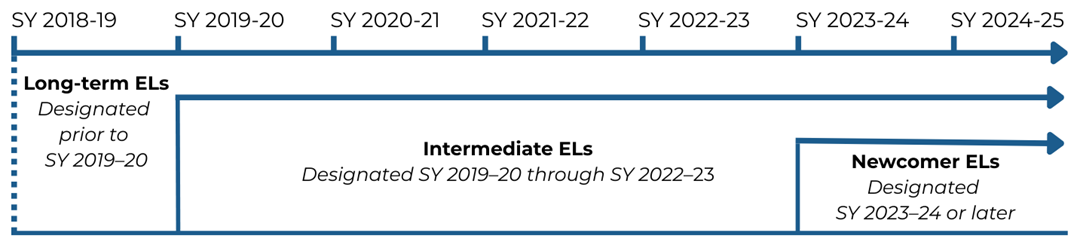
For this study, we used the classifications shown in Figure 3 to categorize students based on the length of time they had been identified as ELs.
While we found no statistically significant impact for LTELs in ELA, we did find positive effects for other EL groups. Newcomer ELs demonstrated gains equivalent to an eight-percentile-point improvement, and combined newcomer and intermediate ELs showed moderate gains of approximately six percentile points. We observed stronger outcomes among students whose teachers fully implemented all curriculum units and participated in the complete professional development and coaching sequence.
Although district testing timelines limited our ability to analyze ELP outcomes for the full sample, a subset of students who completed at least eight weeks of implementation before we assessed them showed statistically significant improvements in Writing, Listening, and Speaking. These gains were nearly twice the typical annual growth rate of similar students.
Our exploratory analyses identified meaningful positive effects for several EL subgroups. These findings support a Tier 3 ESSA classification and demonstrate promising potential to improve language development and academic progress among multilingual learners.
Understanding the study findings requires attention to several important contextual factors.
Changes in federal education funding processes and in grant administration within the U.S. Department of Education coincided with this study’s implementation period. During this time, shifts in discretionary funding priorities and adjustments to grant timelines contributed to variability in the broader education research landscape. These ecological conditions had implications for planning, coordination, and expectations for education research and development efforts, including government-funded work supporting ELs. While this project continued to move forward, the broader context is relevant for interpreting implementation decisions and sustained federal support.
The Center originally designed E-ELA for LTELs and intended it for districts serving large LTEL populations. Because many of the originally contacted districts had recently received ESSER funds to pilot new ELA curricula or supplemental materials, they were not interested in switching to E-ELA for 12 weeks during the pilot year. This resulted in unexpected recruitment challenges that expanded implementation to districts with mixed-proficiency classrooms. In these classrooms, newcomers, LTELs, and other ELs learned together. Teachers, therefore, made minor pedagogical adaptations to the materials to meet a broader range of language and learning needs than initially planned.
Implementation delays shifted instruction into the spring semester, when testing schedules and competing school priorities affected pacing and prevented some teachers from completing all three units. Early administration of ELP assessments in several districts also meant that many students had limited exposure to the curriculum before testing, reducing the strength and generalizability of ELP findings.
Despite these constraints, teachers reported strongly positive experiences with E-ELA. They described the curriculum as more engaging and better aligned to ELs’ needs than typical ELA materials and expressed clear intentions to continue using the instructional strategies and tools introduced through the project.
Together, these considerations provide context for interpreting the results and highlight the Center’s continued promise to expand multilingual learners’ access to rigorous, grade-level instruction.
